
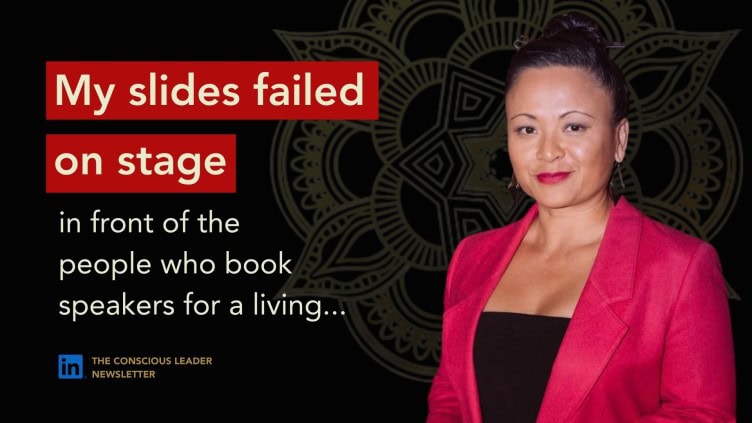
My slides failed on stage, in front of the people who book speakers for a living.
It was Marina Bay Sands in Singapore. I was the opening speaker at a conference for marketers, event managers, speaker bureaus and agents. If there was ever an audience designed to catch a speaker losing composure, it was this one.
My slides were running several seconds behind every click. The technical team decided the problem was on my end, and told me so.
It wasn’t. Every other speaker’s slides were delayed that day too. But I didn’t argue. I asked one question: “What do I need to do?”
I sat down with one of the organisers, built a new presentation from scratch and sent it through. Then I walked on stage, and the old slides were on the screen.
So I said it out loud: “I want to acknowledge that what you are watching right now is a live demonstration of exactly what I am about to talk about. The environment is not cooperating. My slides are running on the wrong deck. The delay is real. And none of that is changing what I am going to give you today.”
The room laughed. Then they leaned in.
· · ·
The order I did it in.
I didn’t spend any time on whose fault it was. I asked what I needed to do. And when the fix didn’t make it onto the screen, I told the room what was happening, before they had to wonder whether I’d noticed.
The room responded to that last part. A room relaxes when the person at the front says out loud what everyone can already see.
· · ·
Where most of us get it backwards.
Under pressure, most leaders run it the other way round. First we work out whose fault it is. Then we try to fix it quietly. And we tell the people watching last, if we tell them at all.
It looks like the number you talk around in the board meeting.
The delay you keep calling “on track”.
The restructure everyone’s whispering about that nobody in leadership will name.
The client you’re about to lose that the team keeps asking about.
Your people can see all of it. They’re waiting to find out whether you’ve noticed.
· · ·
This week,
The next time something goes wrong in front of your team, try the order I used that day.
Ask “What do I need to do?” before you ask whose fault it is.
Say what’s happening out loud, in a sentence or two, the way you’d say it to a friend.
Then tell them what isn’t changing.
For me, that day, it was what I’d come to give that room.
With Love, Pauline
This first appeared in The Conscious Leader, my weekly LinkedIn newsletter. Subscribe on LinkedIn.